
Designing for Human Capacity: Why Wellness Must Move Upstream
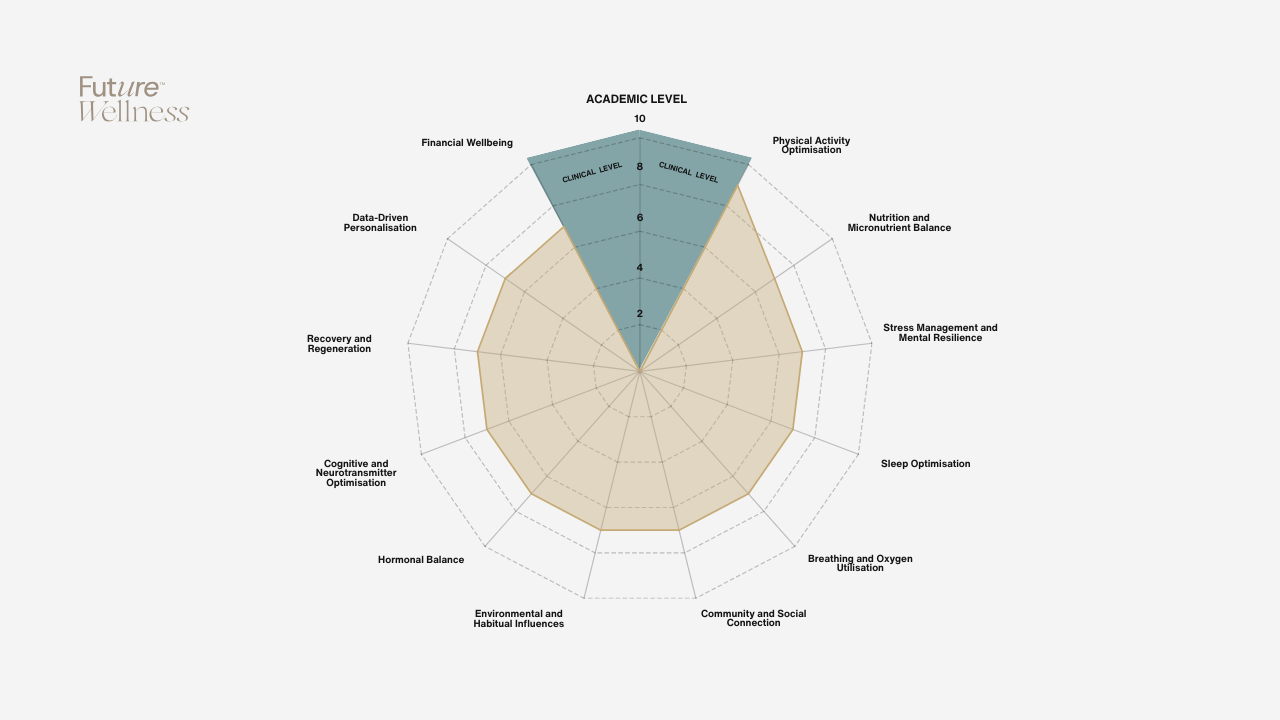
What this model captures, and what most wellness frameworks miss, is concurrency.
These spokes do not act as independent optimisation targets. They behave as a coupled biological system, where change in one domain produces second- and third-order effects across the others. That is precisely why sub-clinical intervention is the level society now needs, not diagnosis, not treatment, but systemic load reduction and alignment before pathology emerges.
Below is how to think about this model in a way that is biologically honest, socially scalable, and commercially realistic.
1. Concurrency, Not Sequencing
In real human systems:
-
Sleep alters hormonal tone
-
Hormonal tone alters stress resilience
-
Stress resilience alters cognitive bandwidth
-
Cognitive bandwidth alters behaviour, nutrition, and social engagement
-
Behaviour feeds back into sleep and recovery
This means:
You never “fix” one spoke in isolation.
At a population level, single-domain interventions (sleep apps, fitness challenges, mindfulness sessions) consistently underperform because they ignore cross-load.
This model correctly reframes wellness as:
The management of interacting biological pressures, not isolated behaviours.
2. Why Sub-Clinical Is the Correct Intervention Layer
Most of society does not need:
-
Medical diagnosis
-
Clinical therapy
-
Specialist treatment
What they do need is:
-
Reduced baseline physiological noise
-
Improved circadian and nervous system coherence
-
Better environmental and behavioural defaults
In other words:
Fewer people need treatment if more people receive earlier system-level support.
Sub-clinical intervention sits in the zone where:
-
People are functional but depleted
-
Performance is present but fragile
-
Symptoms exist but are non-diagnostic
This is the largest unmet need in modern health.
3. How the Spokes Influence Each Other (Key Couplings)
Rather than listing each spoke in isolation, the value is in the pressure pathways between them.
Sleep ↔ Stress ↔ Cognition
-
Poor sleep increases amygdala reactivity
-
Elevated stress hormones reduce prefrontal control
-
Cognitive fatigue drives compensatory behaviours (stimulants, poor nutrition)
Sub-clinical intervention:
Light exposure, timing discipline, cognitive load management, not sleep medication.
Nutrition ↔ Hormonal Balance ↔ Energy Regulation
-
Micronutrient insufficiency blunts mitochondrial output
-
Hormonal dysregulation alters appetite and motivation
-
Energy instability reduces movement and recovery quality
Sub-clinical intervention:
Chrono-nutrition, adequacy before optimisation, removal of dietary noise, not restrictive dieting.
Physical Activity ↔ Recovery ↔ Nervous System Tone
-
Training without recovery increases allostatic load
-
Elevated sympathetic tone disrupts sleep and digestion
-
Fatigue masquerades as “lack of motivation”
Sub-clinical intervention:
Load management, parasympathetic biasing, movement variability, not more intensity.
Environment ↔ Breathing ↔ Sleep ↔ Cognition
-
CO₂, light, temperature, and noise subtly degrade physiology
-
Breathing patterns adapt to stress and environment
-
Cognitive performance falls before symptoms are noticed
Sub-clinical intervention:
Environmental design and habit architecture, not behavioural willpower.
Community ↔ Stress ↔ Financial Wellbeing
-
Social disconnection amplifies stress perception
-
Financial instability increases cognitive threat load
-
Chronic vigilance reduces recovery capacity
Sub-clinical intervention:
Predictability, social rhythm, psychological safety, not resilience training alone.
4. Why This Model Is Fit for Society (Not Just High Performers)
This framework works at scale because it:
-
Does not medicalise normal human strain
-
Does not rely on high compliance or motivation
-
Does not require specialist access
Instead, it focuses on:
-
Defaults over decisions
-
Environment over education
-
System design over individual blame
This is exactly what modern society requires:
Low-friction, biologically intelligent support that reduces background load.
5. The Strategic Insight
The centre of this model is not “wellness”.
It is biological capacity under modern load.
When these spokes are aligned:
-
Fewer people burn out
-
Fewer people escalate into clinical systems
-
Performance, well-being, and resilience improve simultaneously
This is why the model works equally well for:
-
Hospitality
-
Corporate environments
-
Education
-
Public health
-
High-performance settings
Because it operates before failure, not after it.
The Core Principle
Society does not need more interventions.
It needs fewer conflicting pressures acting at the same time.
And this is exactly why the Future Wellness Academy exists.
The problem isn’t a lack of science.
And it isn’t a lack of awareness.
The problem is that the people who shape environments, schedules, services, and systems are rarely trained to understand biology as an operating constraint.
Most professionals influencing human outcomes, in hospitality, workplaces, education, performance, and health, make decisions every day that directly affect sleep, stress, recovery, cognition, and long-term resilience.
But those decisions are usually made through operational, aesthetic, or commercial lenses alone.
The Future Wellness Academy exists to close that gap.
Not by creating more wellness practitioners.
And not by asking individuals to try harder.
But by training a new class of professionals to think biologically before they think operationally.
So biological intelligence becomes embedded upstream, in design briefs, schedules, environments, and defaults — rather than pushed downstream onto individual behaviour.
That’s how regulation becomes passive.
That’s how load is reduced at scale.
And that’s how we move from treating failure to designing for capacity.
That is the problem the FWA is here to solve.